

Lake Kerkini National Park, the History, part 1
The Kerkini Lake National Park is located in the northwestern part of the prefecture of Serres. The Kerkini wetland, which constitutes the central part of the National Park, is one of the 10 wetlands of international importance in Greece, also known as Ramsar wetlands.
It is also one of the 196 Important Bird Areas (IBA) of Greece and a Special Protection Area (SPA 79/409/EEC, as amended by Directive 2009/147/EEC), as well as a NATURA 2000 site (Directive 92/43/EEC).
The lake was created in 1932 with the construction of a dam on the Strymon River, in the northwestern part of the Serres plain near the village of Lithotopos, the construction of a large embankment on the eastern side of the lake and a smaller one on the western side that protected the settlement of the village of Kerkini. The purpose of the creation of the lake was to stop the flood flows of the Strymon, to retain the transported materials and to irrigate the Serres plain. In the place where it was created, there were small lakes in antiquity as well as permanent and temporary marshes. In the southern part of the Serres plain there was Lake Achinou, which dried up at the same time.
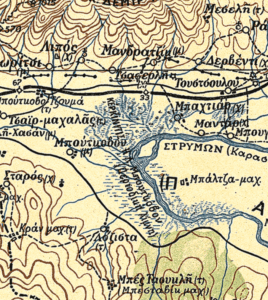
The area of present-day Kerkini in 1914
The Strymon originates from Mount Vitosha in Bulgaria and flows through the Rupel Straits into the Serres Plain, where it usually follows a southeasterly direction, to finally flow into the Strymon Gulf. During the twenty years 1914-1934, 5 major changes in the riverbed occurred, while in the period 1918-1934, 7 years of flooding occurred. During the Asia Minor Catastrophe, a large number of refugees settled in the area. The miserable living conditions and the malaria endemic in the area led to the death of approximately 20% of the refugees. This was probably the main reason that prompted the Greek state to build large land improvement projects in the plains of Macedonia, namely the rehabilitation of the refugees and the fight against malaria.
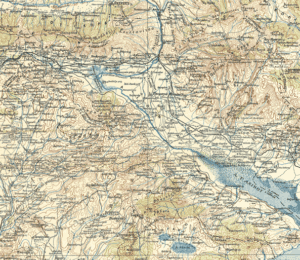
The area of today’s Prefecture of Serres as it was in 1914
The works in the Serres plain were constructed by the joint venture of the American companies John Monks & Sons – Ulen & Company. In addition to the construction of the lake, the companies’ contract included many other works such as the diversion and casing of the Strymon upstream of the lake, the drainage of Lake Achinos, the arrangement and casing of the riverbed downstream of the lake, casing of the Belitsa ditch and the main streams of the plain and the construction of 3 water intakes and the main canals for irrigation.
These works, with the exception of the section of the Strymon bed that passed through the former Lake Achinos, were completed in 7 years. In the following decades, various projects were constructed, the main ones concerning the Kerkini area (construction of a new dam and embankments to increase the capacity of the lake, rearrangement of the riverbed upstream of the lake and irrigation works in the plain). These projects were completed in the 1980s, but many of them presented serious problems over the years, either in terms of construction or design, as a result of which they do not currently meet their role.
Did you know that:
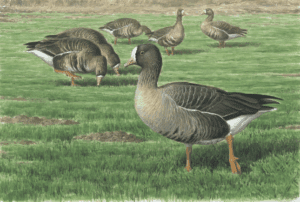
The Lesser White-fronted Goose is one of the most endangered bird species
in Europe. Almost the entire European population of the
species winters in the Kerkini Lake National Park, where it remains for 5 to 6 months each year,
more than in any other country or region.